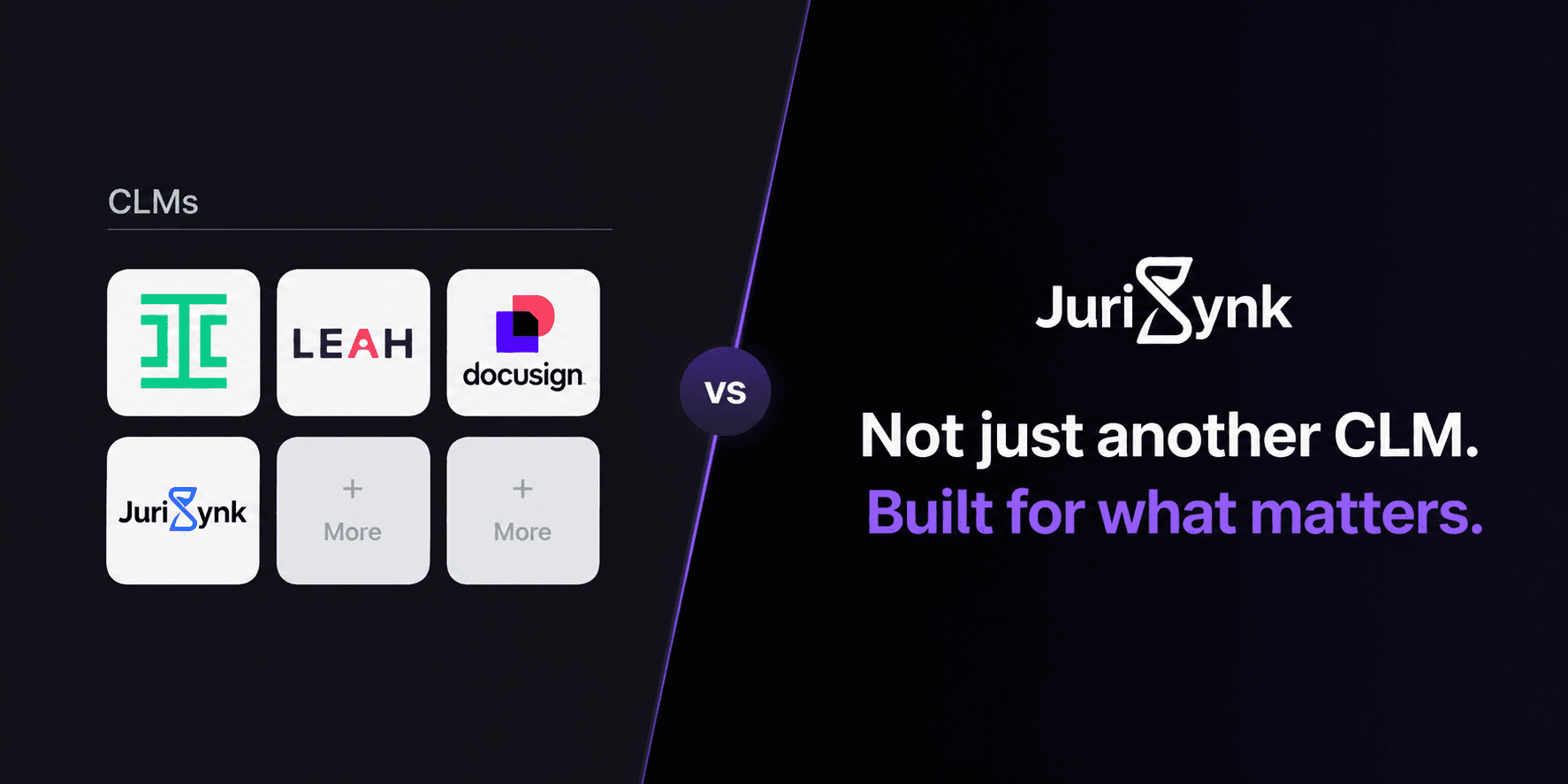
Harvey's world — and its edges
Harvey is remarkable. $1.2B raised, $11B valuation, 100,000 lawyers across 1,300 organizations. Its LexisNexis partnership, Vault document intelligence, and 25,000+ custom agents make it the clear choice for Am Law 100 firms and Fortune 500 legal departments with the budget and infrastructure to match.
But Harvey's estimated $288,000 annual entry point — 20-seat minimum, ~$1,200/seat/month — defines its natural boundary. Beyond that boundary sits a vast, underserved market: mid-size law firms running transactional practices, in-house deal teams closing acquisitions, bid desks racing tender deadlines, and procurement functions drowning in vendor paper. These teams do the same legal work at a fraction of the budget. Harvey wasn't built for them. Jurisynk was.
“Harvey's pricing isn't a flaw — it's a feature of its market. The gap it leaves is the entire opportunity Jurisynk is built to serve.”
Who Jurisynk serves
Jurisynk is built for four distinct legal teams that Harvey's pricing structurally excludes:
- Transactional law firms. Mid-size and boutique firms running M&A, PE, and corporate advisory work — where deal velocity and margin both matter, and BigLaw tooling is out of reach.
- In-house deal teams. Counsel managing live M&A, JV, and investment transactions — dataroom reviews, NDA cycles, acquisition docs — without a full legal ops team behind them.
- Bid and tender teams. Teams racing submission deadlines who need rapid T&C markups, risk flagging, and compliance reads across large tender documents.
- Procurement and vendor legal. Procurement leads managing high volumes of vendor MSAs, SOWs, DPAs, and SLAs where consistent autonomous review is the bottleneck.
Head-to-head
Target market
Harvey: Am Law 100 · Fortune 500 legal departments. Jurisynk: Law firms (transactional practices) · in-house deal, bid & procurement teams.
Pricing
Harvey: Est. ~$1,200/seat/month · 20-seat minimum · ~$288K annual entry. Jurisynk: A fraction of Harvey's cost — designed for teams without a BigLaw AI budget.
Agent model
Harvey: Workflow agents on a builder canvas; human-directed throughout. Jurisynk: Fully autonomous agents — contract review, redlining, negotiations, and dataroom reviews execute end-to-end.
Negotiations
Harvey: Playbook-guided drafting; negotiation positions require lawyer input at each step. Jurisynk: Autonomous contract negotiations — agents handle counterparty redlines, positions, and back-and-forth natively.
Dataroom review
Harvey: Vault for bulk document analysis; deal-level setup required. Jurisynk: Autonomous dataroom review — agents ingest, categorize, flag, and surface issues across entire deal rooms.
Collaboration
Harvey: Shared Spaces for firm-client workflows; document-centric. Jurisynk: Canvas — an interactive workspace where legal and business teams review, annotate, and resolve issues together in real time.
Native home
Harvey: Harvey's own platform, mobile app, or Word add-in. Jurisynk: Lives natively inside Outlook, Gmail, and Word.
Memory
Harvey: Firm-level via Vault and DMS integrations (iManage, SharePoint, NetDocuments). Jurisynk: Three-layer: deal-level, end-client-level, and institutional — context that compounds with every transaction.
Autonomous — not assisted
Every legal AI tool from 2023–2025 made lawyers faster at things lawyers already do. You open a platform, write a prompt, review an output, paste it somewhere, send it. The AI shaved 40% off a task that shouldn't need a human at all.
Jurisynk's agents don't assist — they operate. A contract lands in your inbox. The agent reviews it against your institutional playbook, generates redlines with risk commentary, handles counterparty negotiations, and delivers a resolved draft back to your Canvas — without you touching it. You engage when judgment is needed. Not when work is being done.
For law firms, this means more deals handled per associate. For in-house teams, it means the back-office runs itself.
Canvas: where the deal lives
The hardest part of transactional legal work isn't the review. It's everything after it — the redlines in email chains, the business context in Slack, the partner call to explain what the AI flagged, the version nobody can find.
Canvas brings it together. It's a collaborative, interactive document workspace where AI-generated review outputs — inline comments, risk flags, negotiation positions, version history — are visible and actionable by both legal and business stakeholders in one place. The conversation about the contract happens inside the contract.
Memory that compounds
Most legal AI tools have the memory of a goldfish. Every new matter starts from scratch. Jurisynk operates across three layers of memory:
- Deal-level memory. Every document, thread, and decision within a transaction is remembered. Agents never lose context mid-deal.
- End-client memory. Counterparty preferences, past positions, and negotiation history — every interaction with that party gets smarter over time.
- Institutional memory. Your firm's or company's standard positions, risk thresholds, and playbooks — baked in, applied consistently across every agent action.
Harvey stores your documents. Jurisynk learns from them. The tenth deal runs faster than the first, with more accurate positions and richer counterparty context. That compounding is the moat.
The verdict
Choose Harvey if you're an Am Law 100 firm or Fortune 500 legal department with a large team, DMS infrastructure, LexisNexis access, and the budget to match. Harvey is world-class for that context.
Choose Jurisynk if you're a transactional law firm or in-house deal, bid, or procurement team that wants fully autonomous agents — at a price point that actually fits your size and velocity.
Harvey owns the top of the legal AI market. The transactional middle — the law firms running 50 deals at once, the GC managing three live acquisitions, the bid desk submitting by Friday — that market is wide open. That's Jurisynk's race to run.
Share this article

Written by
Manan Dubey
Co-founder and CEO, SYNK AI
Passionate about leveraging AI to transform the legal industry and help law firms work smarter.