There's a conversation happening in every fast-growing Indian fintech right now. The business is scaling. Vendor contracts, SaaS agreements, DPAs, MSAs — they're piling up. And somewhere in the middle of it all, a GC with two junior lawyers is drowning.
The standard advice is: get a CLM.
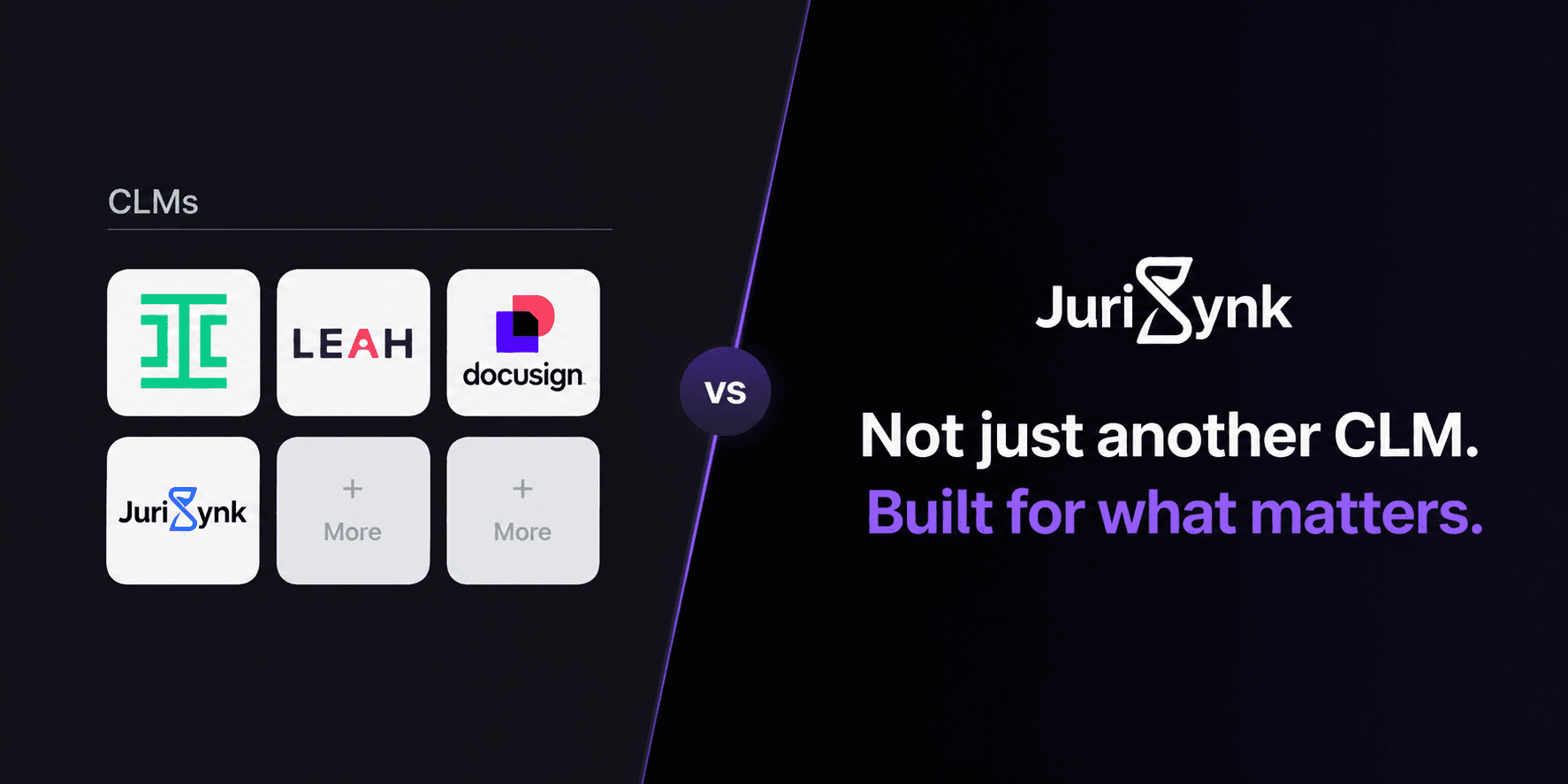
So they demo Ironclad. They look at DocuSign CLM. They sit through a Leah walkthrough. Some of them buy. And six months later, the contracts are better organized — but the GC is still the bottleneck.
The problem was never that contracts were disorganized. The problem was that there aren't enough lawyer-hours to do the work.
CLMs don't fix that. They never claimed to.
What CLMs Actually Do
Contract Lifecycle Management platforms were built to solve a real problem — the chaos of managing hundreds of contracts across a large organization. Templated drafting, approval workflows, clause libraries, obligation tracking, renewal alerts. For a 20-person legal team at a large enterprise, that infrastructure is genuinely valuable.
But the architecture underneath every major CLM is the same. It's a system designed to support human-driven workflows. A lawyer initiates a contract request. The system routes it. A lawyer reviews it. The system tracks the approval. A lawyer signs off. The system stores it.
The AI features layered on top — clause extraction, risk scoring, AI-assisted drafting — make individual steps faster. They don't change the fundamental equation: every contract still needs a lawyer to touch it at every meaningful decision point.
Leah, the most agentic-positioned CLM on the market, states this plainly on their own website. CLM platforms were built for human workflows. AI on top makes them faster. It does not make them autonomous.
For a 200-person legal team at a global enterprise, faster is fine. The bottleneck isn't throughput — it's visibility and governance.
For a 5-person in-house team at a Series B fintech, faster isn't enough. The bottleneck is pure capacity. And no amount of workflow optimization fixes a capacity problem.
The Real State of In-House Legal at Indian GCCs
Here's what a typical day looks like for a GC at a mid-size Indian fintech or GCC:
Fourteen open contract threads across email. Three vendor NDAs waiting for review. A DPA negotiation with a European SaaS provider that requires GDPR clause analysis. Two MSAs from last week that haven't been touched. A Slack message from the CFO asking about the indemnity cap on the AWS agreement signed eight months ago. A meeting in an hour.
None of this gets solved by a better contract repository. It gets solved by having more hands on the work.
“The question Jurisynk starts from isn't "how do we organize your contracts?" It's "what if your legal team didn't have to do most of this work in the first place?"”
Jurisynk Is Not a CLM
This is worth saying directly, because the category comparison will come up.
Jurisynk deploys autonomous AI agents that handle contract review, redlining, drafting, and DPA negotiations natively inside Outlook, Gmail, and Word — the tools your legal team already works in. There is no new platform to log into. There is no implementation project. There is no six-week playbook configuration.
A contract lands in your inbox. The agent reviews it against your standard positions, flags material risks, generates redlines with tracked changes in Word, and surfaces a summary — before you've had your morning coffee.
But that's just the single-contract case.
The part that changes the economics of an in-house legal team entirely is what happens at scale.
When a company runs a large vendor consolidation exercise, or an M&A team needs due diligence across an acquired entity's entire contract portfolio, or a compliance team needs to audit thousands of legacy agreements for a new regulatory requirement — that work is traditionally either outsourced to a law firm at enormous cost or it simply doesn't get done thoroughly. Jurisynk can process 10,000 documents at once. Bulk analysis across an entire contract corpus — extracting clauses, flagging risks, surfacing anomalies — in a fraction of the time any team could do it manually.
“That is not a faster workflow. That is a different order of magnitude.”
Playbooks That Actually Get Followed
One of the persistent frustrations in any in-house legal team is playbook drift. The GC spends weeks building a negotiation playbook — preferred positions on indemnity, liability caps, IP ownership, data processing terms. It gets saved in a shared folder. Juniors reference it inconsistently. External counsel ignores it. Six months later, contracts are being negotiated off-playbook because nobody has time to check.
Jurisynk enforces playbooks at execution time, not as a reference document. Every review, every redline, every flagged clause is run against the team's actual negotiating positions. The agent doesn't approximate — it applies the playbook. When a counterparty pushes back on a clause, the agent knows what the fallback position is and applies it. When something falls outside the playbook entirely, it escalates to the lawyer rather than guessing.
This matters because it turns playbook compliance from a training problem into a system guarantee. The GC writes the playbook once. Every contract that passes through Jurisynk honours it — whether it's the third contract that week or the three thousandth.
Collaboration That Doesn't Create Version Chaos
The other problem CLMs don't fully solve — and that every in-house team knows intimately — is the collaborative review process. A contract goes to the lawyer, who marks it up in Word and emails it back. The business team makes comments. Legal responds. The counterparty sends a revised version. Now there are four versions of the same document across three email threads and nobody is sure which is current.
Jurisynk's Canvas gives legal teams a shared workspace where contracts live during the review and negotiation phase. Inline AI-generated review comments sit alongside team annotations. Version history is captured automatically — every change, every round of negotiation, every approval is auditable. When the CFO asks in six months why a particular clause was accepted, the answer is in the audit trail, not in someone's memory.
This isn't a contract repository. It's where the work happens — collaboratively, with full visibility, before anything gets executed and filed elsewhere.
Where Jurisynk and CLMs Actually Fit Together
Here's where the conversation gets more honest.
CLMs are good at things Jurisynk isn't designed to replace. Repository management — a single source of truth for executed contracts. Obligation tracking — renewal dates, notice periods, auto-alerts. Approval workflow routing across large organizations. Compliance reporting at enterprise scale.
Jurisynk handles everything that happens before a contract reaches that state. Review. Negotiation. Redlining. Bulk analysis. Playbook enforcement. Collaborative drafting. The cognitive and operational labor that creates the bottleneck.
These aren't competing layers. They're sequential.
A contract comes in via email. Jurisynk's agent reviews it, generates redlines against your playbook, handles negotiation rounds with the counterparty, and tracks every version through Canvas. Once executed, it flows into your CLM — Ironclad, Provakil, DocuSign — for storage, obligation tracking, and renewal management.
“Jurisynk handles the work. The CLM handles the record.”
For teams already running a CLM, this means their existing investment doesn't get displaced — it gets made more useful. Contracts arrive in the CLM already reviewed, already clean, already tagged. The CLM becomes a governance layer over work that Jurisynk has already done, with a complete audit trail attached.
For teams that don't have a CLM yet — which is most of the in-house teams at Indian fintechs and GCCs — Jurisynk is the right first purchase. Solve the throughput problem first. Add governance infrastructure when you have the volume that warrants it.
The Question Worth Asking Your CLM Vendor
Next time you're in a CLM demo, ask this: after I buy this, how many contracts can my team handle per week?
The honest answer is: roughly the same number as before, minus the administrative overhead.
The throughput ceiling is your team's capacity. CLMs optimize within that ceiling. Jurisynk raises it — and at bulk scale, removes it almost entirely.
“That's the difference between a tool and an operator.”
Share this article

Written by
Manan Dubey
Co-founder and CEO, SYNK AI
Passionate about leveraging AI to transform the legal industry and help law firms work smarter.